GEARS- Lexus 8-Speed June 2020 GEARS article by Mike Brown
Thursday, September 24, 2020

Friday, September 18, 2020
Thursday, September 3, 2020
Friday, August 21, 2020
Ford F350 KOEO 334
I've been running KOEO tests on this 1997 F-350 truck while waiting for the intermittent no-start to rear its ugly head once again. I'm getting nowhere on that problem until it does. Meanwhile, I'm getting 334 and 654 as current codes. Even though this truck is 1997 the self diagnostic system is EEC IV. I had a decent coverage on EEC IV testing HERE.
The code description for 334 is "EGR (EVP) closed valve voltage higher than expected".
What to know here is that there is a EGR VALVE POSITION sensor mounted to the top of the EGR valve by 3 small bolts. The sensor voltage to the engine computer is how the computer determines EGR valve position. As the EGR valve moves, it moves a small steel shaft that is part of the position sensor. The movement of that shaft varies the voltage from the sensor.


The 334 is setting with KEY ON, ENGINE OFF. The engine runs fine at idle. If the EGR valve was not closing the idle should be rough. The sensor and valve appear to be new. My experience tells me that I likely have the wrong voltage from the sensor. A good place to check voltages is at the sensor connector. I should have KOEO a 5 volt reference, a sensor ground and a sensor signal voltage out to the computer. There are two colors of Ford EVP sensors, the white one is supposed to signal 0.5 volts at closed valve position. When I check the signal I have 0.96 volts. The computer is expecting to see 0.5, gets 0.96 and sets a 334 for higher voltage than expected.


With the correct voltages on the wires to the sensor I loosened the sensor mounting bolts, allowing the sensor shaft to extend slightly and the sensor voltage went to 0.5. A re-test with the correct voltage and the 334 was gone.


The fix here was to slightly grind the end of the sensor shaft. I removed just a bit at a time because you can always make it shorter, but longer isn't gonna happen. Just removed enough metal to let the shaft at rest be in the position to output 0.5 volts.
Next up.... that 654 code.
Thanks!
Kenny@ggauto.repair
Monday, June 1, 2020
Thursday, May 28, 2020
Healthway
Replaced worn out throttle body as authorized.
I noticed a spark plug wire had been arcing (spark) against the fuel line. There are a lot of misfires stored in the computer memory. Most are for #3 cylinder which is the one with the spark jumping from the wire. Worn spark plugs cause the spark to go where it shouldn't and I pulled the #3 plug. I have to think that is original plug. I have never seen a spark plug with that much wear that was still running. The plug wire was broken at the plug end and came completely apart when accessing the plug. So... this needs spark plugs, spark plug wires and ignition coil as well. I've taken the pictures relevant.


I noticed a spark plug wire had been arcing (spark) against the fuel line. There are a lot of misfires stored in the computer memory. Most are for #3 cylinder which is the one with the spark jumping from the wire. Worn spark plugs cause the spark to go where it shouldn't and I pulled the #3 plug. I have to think that is original plug. I have never seen a spark plug with that much wear that was still running. The plug wire was broken at the plug end and came completely apart when accessing the plug. So... this needs spark plugs, spark plug wires and ignition coil as well. I've taken the pictures relevant.


Friday, May 1, 2020
Sensor Types: Thermistor
A thermistor is a resistor that changes value according to temperature. They are often used as temperature sensors. We'll use the coolant temperature sensor from a '98 Chevy truck for an example of a thermistor type sensor. This sensor is for the temperature gauge operation. Room temperature is about 80F and we have a chart of rough resistances at various temperatures.


The resistance of the sensor falls within range.


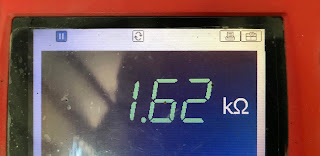


The resistance of the sensor falls within range.

We should see a change if we heat it up to around 100F.


Or cool it down to around 30F.


So that is how a thermistor type sensor works!
Thanks for reading
kenny@ggauto.repair
G&G Auto Repair
Subscribe to:
Posts (Atom)