This was a very comprehensive and useful series. It is old now but I'd hate to see it lost and Motor magazine has a great archive. Let's use it.
You get some good tips and better understand the EVAP system.
Kenny@GGAuto.Repair
This was a very comprehensive and useful series. It is old now but I'd hate to see it lost and Motor magazine has a great archive. Let's use it.
You get some good tips and better understand the EVAP system.
Kenny@GGAuto.Repair
One of the most common falsehoods you'll hear concerning car repair is that trouble codes will tell you what is bad on your car. Just read the code and know what the problem is. There is no truth in that statement and, for some reason many people believe it anyway. I imagine it gets tossed out there most often by misleading ads from makers of code readers. I can tell you this, if a code reader would diagnose a car problem I wouldn't spend any time learning how systems work, how to test operation or definitely wouldn't spend so much money on testing equipment.
If you were driving a car and noticed a problem that you felt should be checked out, you would bring the car in and describe what you are noticing. Coming in and saying something is looking like a problem on my car, with no more information, then I'd have a really hard time determining what you are seeing that you are worried about. A warning light coming on in your car is the equivalent of that. The light is just saying hey I noticed something. If it stopped there I would have an extremely hard time determining the problem. If you said I noticed a problem with the engine sometimes being hard to start, idling rough and black smoke, then I would know what sort of things to start checking to determine the problem. Trouble codes are the way the car tells you more about what it is seeing that looks like a problem. It is giving you a place to start testing to determine the problem.
If I need more information from you about the problem, I ask for it. If I need more from the car computer, I use a scan tool to look a bit further. So, I ask for it.
Let's walk through one. 2012 Ford Edge Limited 3.5 Because the Malfunction Indicator Light is on and because that just means there is a problem, I need codes. I don't need codes to tell me what is wrong, because they don't. But I do need codes to know what sort of concerns the computer has noticed.

I have saved this article for many years, but not the magazine issue so I'm not sure the exact month/year it was originally published. It rang so very true then and unfortunately even now. I've done my part over the years, trying to educate my customers about what diagnostics actually is and how it is accomplished but I will admit that I am outnumbered by the sheer amount of false information out there. Anyway, I'll reproduce the article here. .... Kenny
Motor Age
The Most Widely Believed Myth
It is a widely believed myth. In fact, it may be the most widely believed myth in modern American society. It is a myth that is detrimental to the automotive repair industry in general and to its most skilled and experienced members in particular. Yet, despite this fact, it it actually believed by some members of this industry. It is the diagnostic machine myth - the belief that machines diagnose automotive faults.
Those of us who diagnose automotive faults for a living, whether said faults are of a mechanical, electrical or computerized nature - and all of these are subject to the belief that some machine exists which can diagnose them - know this to be a ridiculous belief. This is not to say that those pieces of test equipment which are commonly referred to as 'diagnostic machines' are not useful in the course of fault diagnosis. They are, in fact, necessary to the process in many instances. Regardless of this, however, these machines are simply tools to be utilized by highly skilled individuals, if an accurate diagnosis is to be made. The tracing of an automotive fault requires that a skilled individual determine where the fault lies, based on the results of tests made using 'diagnostic machines' and other pieces of test equipment. In addition, the specific machines to be used and the exact tests to be made must be decided upon by someone possessing the proper, high level of knowledge and skill.
Motorists not only find this myth easy to believe, but they are comfortable with it. In fact, most of them are far more comfortable with the belief that machines or, in some cases, on-board computers will tell repair personnel where faults lie than they are with entrusting a diagnostice task to automobile technicians, whom they find hard to envision as being highly knowledgeable and skilled.
Unfortunately, the myth lives on unchecked, despite the fact that it harms our industry by allowing motorists to believe that an automotive fault, or even a number of faults, can and should be diagnosed for a fixed, nominal fee. This thinking can make it virtually impossible to convince repair customers that several hours of testing time might be needed to diagnose faults in high-tech systems when extensive, hands-on tests are required. It also allows them to believe the greatest skill that we must possess is that of attaching the 'all-powerful' machine to their vehicle.
The diagnostic machine myth is a major factor in our industry's inability to gain motorists' respect because it allows them to mentally avoid giving us credit for the technical skills that we must possess in order to repair modern automobiles. Dispelling this myth is not something that can b accomplished by individual members of the repair industry. However, an organized effort by this industry's members and its many organizations could go a very long way toward correcting motorists' false perceptions of us and the work we do.
Kevin Carpenter owns Automotive Electronics Specialists in Sacramento, CA. He has specialized in driveability and electrical systems diagnosis for more than half of his 21 years in the automotive industry. Prior to opening his specialty shop, Kevin received an associate degree in Computer Electronics from Sacramento's American River College.
-----------------------------------------------------------------------------------------
I don't have an answer and the myth has just grown over the years. I guess I just keep doing my part and explain as I can.
Kenny
Wednesday, July 16, 2008


This seemed like a good time to connect a scan tool to the car. With a scan tool I might see if there was a reason for the PCM to not engage the starter, such as a problem with the anti-theft system.
Well, there was a problem with communication. My scan tool would not communicate with the PCM. When I have that happen I try to make sure I've entered the vehicle information correctly. The information was correct so I tried to use the OBDII system to access the datastream instead of the GM system but still had no communication. It seemed like a good time to try a different scan tool. The second scan tool didn't help. I still had no communication. I checked for power and ground at the diagnostic connector. There should be battery power at pin 16 and ground at pin 4.

The power and ground were fine. A good class II data line communication can be easily seen with a graphing meter. The class II serial data is at pin 2. Sometimes there is a lot of communication, sometimes less. I had communication activity but I couldn't tell if any of that was from the PCM. There are several modules sharing the class II data bus.

What I could tell is that the bus was operating and there was communication on the line. What I wanted to know next is if I had a good bus at the PCM. The class II serial data line at the PCM is at pin 59 of the C1 (blue) connector. I used the graphing meter to check the data line at the PCM by backprobing pin 59 and I had a good bus. Next I cut the dark green wire feeding pin 59. That would mean that any activity I measured on the PCM side of the wire was coming from the PCM and any on the harness side was coming from another module. The harness side had a good signal. There was no signal from the PCM. I made a check of powers and grounds at the PCM connectors and pronounced this PCM dead.
I left the data wire cut and after connecting a new PCM I had a communication signal on the graphing meter coming from the PCM. I repaired the wire and reconnected the scan tool to look for communication. Success! I had a datastream on the scan tool. A peek at trouble codes gave me P1610 Loss of PZM/BCM Serial Data, P1626 Anti-theft System Fuel Enable Circuit and P1631 Theft System Password Incorrect. I guess the most worrisome part was the car still would not start. The starter would not engage. I suspected the P1610 was related to my having the open wire at the PCM connector and that the two Theft system codes could be handled with a password relearn. I cleared the codes from the PCM and used the following procedure to learn a new password.
Turn the key off, wait at least 30 seconds.
Turn the key to start, just as if you are starting the car, then release the key to run, just as if it had started.
The security light should either be flashing or on steady. Just let it do whichever it likes until it goes out completely. This can take as long as 30 minutes.
Once the security light goes out turn the key back to off and wait another 30 seconds.
Go back through the same procedure, turning the key to start, waiting for the light to go out again. You may have to repeat the entire process as much as a half-dozen times.
The first time you turn the key to crank and the car actually starts you are done.
On this car, the third time I hit crank it fired up. I had to go back into the PCM data to clear any codes that set during the procedure (P1630 and P1631) and then it was outta here!
Kenneth Hayes
AKA Deranger
Word on the street is that I have a machine that will tell me what is draining a battery overnight. No. But I do having testing equipment, system data, experience and patience. I also have a typical procedure, but is adaptable to match testing results.
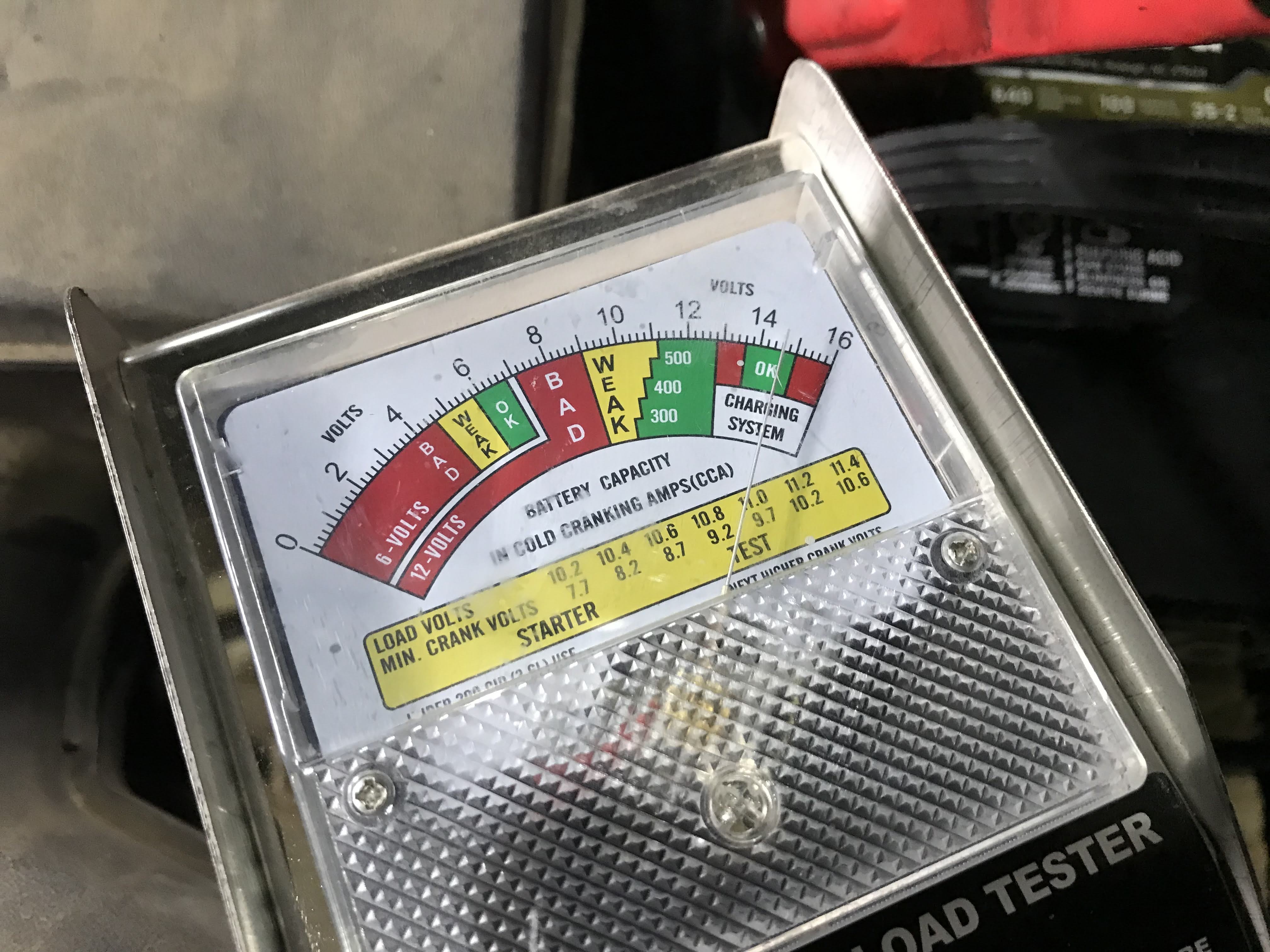
First is, make sure the battery is good and fully charged. This means test and charge as needed. No guessing, no judging based on anything other than testing. This particular battery was new but discharged. You'll need a good, dependable battery charger that reports battery charge condition as a percentage. With the battery still connected to the car, I put the charger on and saw 0%. When my charger sees very low battery condition it goes into "battery saver" mode. Basically that is a trickle charge until the battery begins accepting more charge. So I'm connected and charging in "battery saver" mode, battery is connected to the car. Three minutes later I am showing 99% percent charge, which is a sign of a bad battery or I do have a large drain on the battery and it is interfering with the charge. Disconnecting the battery cables and charging the battery independently gave me a 19% charged reading and more normal charging. I tried testing the battery and saw that I was not going to get by without a charge.


A slow charge is a good charge so this was going to be an overnight charge. You always want to feel the sides of the battery case for any overheating or watch for any over venting, or acid boil. Internal battery faults can cause dangerous conditions and you don't want the car sitting on an overnight charge unless it is safe to do so. Next morning battery is charged and good. I make the first battery test with a load tester, then the digital tester.


Reconnect the battery to the car, making sure the connections are good.
Next step, check the alternator is working properly. At this point all we really have to know is that the alternator is charging the battery when the engine is running. Even though the complaint is a battery draining overnight, the alternator not working properly could cause the battery to be low when the car is shut off, and discharged next morning based on the fact the battery had low voltage when parked. We can do a simple voltage test at the battery and get enough information. Just put a dependable voltmeter on the battery and note the voltage, key off. Start the car and note the voltage with the engine running, if the voltage is more the alternator is charging the battery. That is all we have to know for the purpose of going further in battery drain testing. (Note: if you find your alternator is not working, it does not mean your alternator is bad. It means the charging system needs further testing.)


Was that the problem? A door ajar light staying on? I can verify that. There are two ground cables off the battery and two positive cables. You can check current draw on either positive or negative but you have to check any cable that feeds off that side. The two positive seemed to have enough room for the clamp. I use a clamp because I can do that without disturbing the circuit.


I'm looking for excessive current draw and there is none. I disconnected the sensor at the trunk latch and put the tarp strap back in place. There are limited places to attach a tarp strap on this trunk lid for sure. Now if we had to do this the more tedious way, as in a problem less easily noticed, we would have began pulling fuses, relays, power feeds, etc as we looked for the excessive draw to lead us to the fault.
This one, not so difficult.
Kenneth Hayes
Kenny@ggauto.repair
Thursday, August 23, 2007


FIX:
Replace the A/C Pressure Sensor.
Kenny@ggauto.repair
